Showing posts with label Fredric March. Show all posts

Saturday, January 16, 2021

Death of a Salesman (1951)

 Death of a Salesman (1951)


Written by Arthur Miller
Adapted screenplay by Stanley Roberts
Directed by Laslo Benedek

This is the first movie adaptation of Arthur Miller’s hit American tragedy  play.
It was released in late 1951 two years after the original Broadway production. Mildred Dunnock, Linda Loman from the original production, recreates her performance in the film as well as Cameron Mitchell the original Broadway Happy Loman.

The movie has a terrific central performance with Fredric March as Willy Loman the salesman. He was a terrific film actor and his expressiveness in this powerful role in the great play is a brilliant combination of elements.
Willy is all of us in our competitive commercial market reality. He stands up straight briefly talking proudly about how he was liked and respected which was ultimately what he had to sell, himself. Then he collapses again at the reality of the situation as a victim of the system.

The film has some beautiful transitions from current time to Willy’s dreams of the past. Alex North who did the music for the Broadway production contributes a powerful and appropriate score.

Kevin McCarthy plays Biff. The core of the drama is the conflict between Willy and his drifter son Biff. It is also one of McCarthy’s strongest performances.
We can really only judge actors based on what they are given to do. And here they have the best possible material to work with in this adaptation of Miller’s great American play.

What’s the deal with traveling salesmen in mid-20th Century tragic drama? Hickey, another traveling salesman, is the central character in Eugene O’Neill’s The Iceman Cometh. Part of the downfall of both Willy and Hickey is the guilt of infidelity on the road.  


"Did you hear the one about the traveling salesman?"  

No

"Well, it ain't funny."  


Friday, November 20, 2020

The Iceman Cometh (1973)

 The Iceman Cometh (1973) Written by Eugene O’Neill

                                            Directed by John Frankenheimer


This is a slightly shortened film adaptation of Eugene O’Neill’s enormous, in length and depth, play. It is not for casual viewing. It is a long haul of a heavy load.

The character of Larry Slade acts as a sort of Our Town like stage manager telling us of the scene at the outset. It’s a dive bar in downtown NYC in the early part of the 20th century, the last gasp saloon. A bar and rooming house upstairs owned and run by Harry Hope. The role of Harry Hope is played by Fredric March, the actor 75 years old and here in his final role.
Larry Slade is Robert Ryan, only 63, but also a more or less final performance with awareness of his imminent death from cancer in that same year.
Perhaps that is what helps drive March and Ryan to deliver the most powerful and perfect performances in the movie.

This little look at the movie and play is not going to be able to give much of an insight to the complex psychological mechanism of this play/movie.
It might be best for the reader to seek it out and watch for themselves. It is perhaps best viewed alone, most certainly not a date movie. Maybe best for men or old/soul men, or whatever gender, because it is all about men with no real woman characters other than a couple of hopeless “tarts” who pass through the bar angling for their own hopes which are dependent entirely on these drunken men.

What we have here is a contemplation of life, hope, and death. The “pipe dreams” of hope are delivered to these men through their alcoholism. The drunkenness ignites their hopeful dreams of escaping their current situation and into a future life based mostly on what they were before their fall into this place. The play is entirely set in the bar where they get drunk and dream of escaping to be free, and live again with self, and community, respect.

They wait for Hickey, played by Lee Marvin. Hickey is an on the road salesman, who shows up periodically and flush with enough dough to be the life of the party. He buys them drinks where their usual routine is short on the money to fuel their drunken transcendence day to day.

Only this time Hickey has changed. He is here to confront and murder their hopes and dreams as something in himself has also died between visits.
There is a rather big reveal at the end of this 4 hour epic. This writing will avoid spoiling that for those interested in seeing the movie or play.

That said, the character of Larry Slade comes on hopeless from the very outset. He is an old man, the old anarchist. He has given his life to the movement for social change, economic justice, but has seen this fail. He has seen comrades in the movement disappoint. He has seen them turn on one another. His lofty, idealistic, dreams have been crushed. Yes, there could be a better world, but for something in the people themselves not ready or equipped to make it happen. Perhaps they know the way but cannot make it to the promised land themselves, just too corrupted by the competitive set-up of civilization to return to the garden of tribal hunter-gatherer communist union. He has come to Harry Hope’s to die.
(A pause here to explain the label “anarchist” attached to Larry Slade and its historical perspective. This type of anarchist is not a single bit nihilistic. It's not about destroying everything and burning up the world. The play refers to early 20th century notions of anarcho-syndicalism, as a type of highly idealistic social and economic structure relating to affinity group autonomy that then associates loosely with other affinity groups perhaps based around worker own industrialism. Libertarian communism.)

Larry as a younger man out on the coast has watched the betrayal and failure among these movement people. That betrayal comes and finds him in the bar in the form of the character of Don Parritt, Jeff Bridges, who may even be his own horriblly tragic son.

So at the outset Larry Slade is quite hopeless and welcoming his own death. Yet through the course of the play, through the confrontations with Hickey, the man who loved to put on a party but now the killer of hopes, a pitchman of hopeless and death, a murderer, be sees once again the value of hope and how HOPE IS LIFE and on a sense all the bar inhabitants and perhaps us all, have. His is appalled but murderous Hickey and is his enemy at the end, as we should be too.

The play in the end is an advocacy of hope and dreams as what we have to carry us all through life.


Friday, June 9, 2017

Middle of the Night (1959) and The "May-December" relationship.

Middle of the Night (1959)Directed by Delbert Mann
Written by Paddy Chayefsky

It might be the norm, the usual, but it is also a cliché.
In the May - December male - female relationship the man is powerful and he uses his power to gain sexual access to the young woman. He is her boss at work. He is at least 55 or 60 years old and has spent his life in a productive career so he has top notch housing and has a lot of disposable income to spend on the easily impressed young woman. He has a wife, or has recently abandoned a woman closer to his own age. He has a daughter who is around the age of the younger woman.

The younger woman is either a gold digger, out for his money or at least impressed by it and naturally enjoying the perks of hanging with someone rich and powerful rather than the relatively silly boys of her own age. She has daddy issues. She is inexperienced and naive, maybe not that bright. But she has her youth, her beauty, a nice body, which are her primary assets in the relationship marketplace.

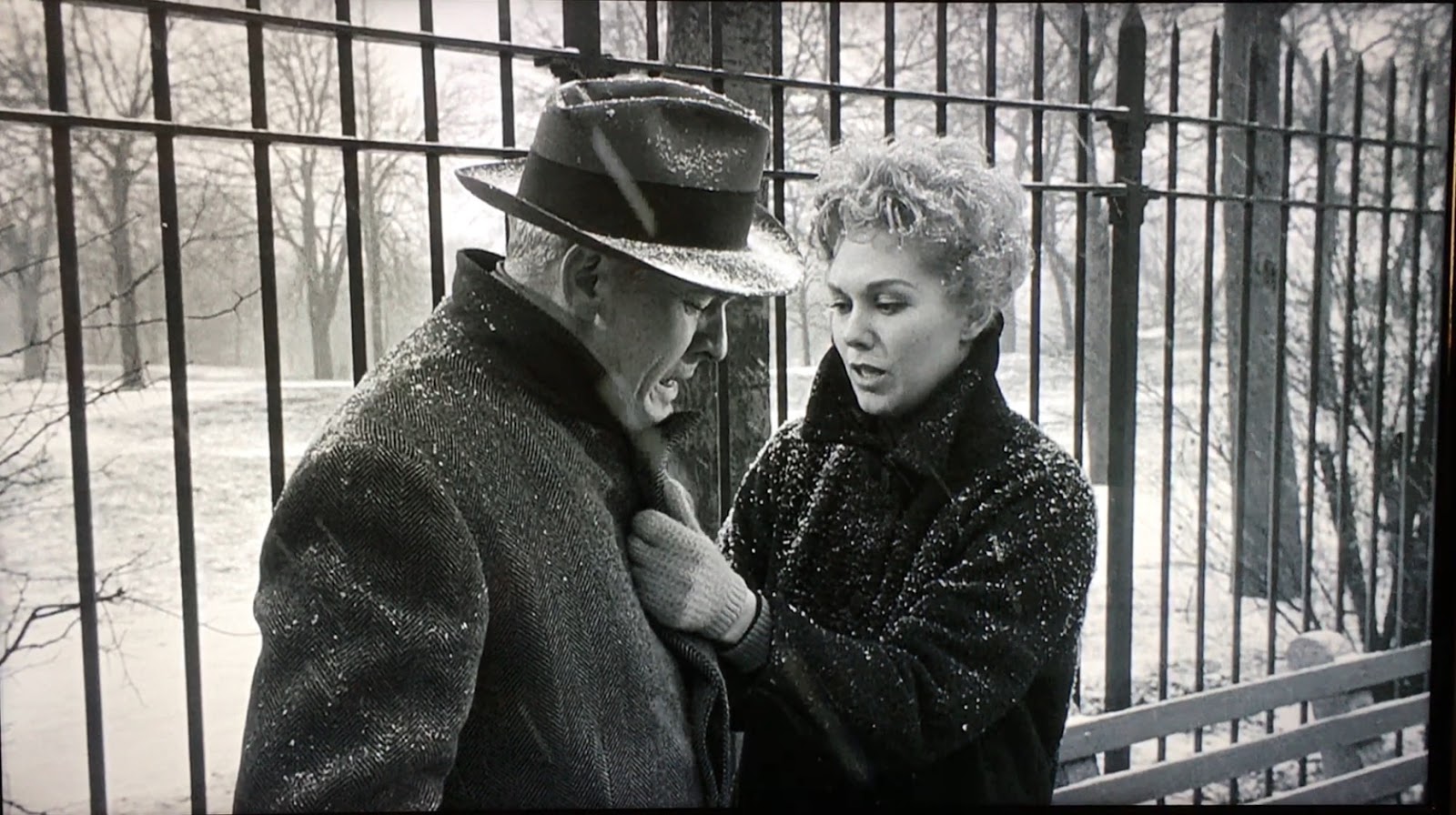
Middle of the Night is a very fine movie. From the leading players on down it is filled with the best actors available. It is shot in B&W on location in New York City. It has some of the best, most real feeling, New York scenes in any movie. It is shot in the winter and the New York winter is allowed to be itself in a way unusual in movies. Principal players do an important  scene in Central Park on a snowing dark cloudy day. Fredric March walks across the street on one of those days when it is sort of raining or snowing, and the street has water puddles and snow and slush. I don’t think I have ever seen a shot like that in a movie. The apartments are real NYC apartments not the enormous apartment sets often in movies that any New Yorker can see as unreal.
The movie is unusual and special because it takes on this topic to begin with. It is a justifiable criticism of movies through the decades that older leading men movie stars are often put in romantic situations with the new young starlet. Like a 25 year age gap between a Cary Grant and and Audrey Hepburn, etc.
In this movie Fredric March plays 56 but he is really 62 and at that age is no longer that handsome leading man of 30 years before. His eyes look saggy, he in not fit, has a belly, he is just not a sex symbol. The woman is played by beautiful blond Kim Novak. She is supposed to be 24 in the movie and is in fact still in her 20s when the movie was made.
He is the boss, she the receptionist, their relationship is not equal, she is a confused divorcee who lives in a very modest apartment with her mother.
He is a widower, has a nice apartment, falls in love with her, is physically forceful at one point, and she is more or less going along with his expressed needs and adoration. But it is not coming from her. He is driving it.
The script is very well crafted. Paddy Chayefsky put his skill as a dramatist to use in this very fine well directed and acted movie. Chayefsky was only in his mid 30s when he wrote this. I don’t know what attracted him about the situation. It has a satisfying yet opened end finale. It is a very good movie.

But what if the man is not particularly powerful? What if he has been more or less a slacker? What if in opposition to having this attractive wealth, he has literally nothing, lives on a tiny fixed income? What if they, once together, have to move in with her parents because he doesn’t have that fancy apartment to share?  There is another side of everything. There is an enormous variety of human experience so this type of May - December relationship happens too.
What if they are same sex or trans people? And a 30 year difference is not the same if the woman is 34 rather than 24, or 44 to his 74.

But what is the drama if there is no disapproving daughter the same age as the young lover? What if she really loves him for the sad lost human he is, who is open about his humanity and capable of a warmth and connection that she finds rare? Well, there might not be a lot of movie type drama in that. These might be the kind of issues that cannot be easily seen in the voyeuristic manner of looking on at lives via a play or movie and judging the characters by their movement and actions rather than what might be going on constantly within them. In this situation she might really adore him but wonder how she will support him and herself, especially as he gets older. She might feel frustrated that she can’t fill out his dreams.
He might worry that he is using up her youth. That he can’t provide for her and liberate her from the drudgery of work or get her a nice place to live like, as he imagines, many other men his age could. (The ones in the movies who have worked hard and accumulated wealth over the years and still have some after the settlement with the ex.) He might be concerned with his health as he ages. He might be OK for the time being and virile enough, but how long can these things last? After all 50 doesn’t seem so long ago, so 80 is right around the corner, it’s it? He might worry that he is not fun enough, and been-there-done-that on too many things she still needs to do. But day to day there might not be a lot of visible drama and it is not easy to show in the movies. But that’s why novels can be so superior to movie fiction, that real internal stuff.

Middle of the Night, written and directed by men, is from the male point of view. It might be somehow progressive for it’s time, but it is still written from the mindset on the 1950s patriarchy. If the culture is to move forward we need to hear from a much wider variety of voices sharing their relationship experiences. Stories like this can often feel terribly stale, along with the male point of view dominant in corporate media, there is also the competitive factor so supported by corporate media with it's endless jealousy stories. Like I said before there is a wide variety of age variant relationships. Same sex, trans, polyamorous, on and on.

In the story of Middle of the Night, why couldn’t she have her retuning young male former husband and well as the older man? Why are they viewed as redundant and competitive when clearly they were suited to and helped full entirely different areas of her emotional need?


MOM

How to destroy a young woman's life? It's really not so hard. Be born to her She was only 19. I understand that she was good in scho...