Showing posts with label Kim Novak. Show all posts

Tuesday, September 14, 2021

Strangers When We Meet (1960)

 I watched this movie on YouTube because I’m a fan of the novelist Evan Hunter. 

The movie is an adaptation of his novel by the same name. Hunter wrote the screenplay. 


This is a really good movie. The two leading actors are Kim Novak, as Margaret (Maggie) and Kirk Douglas, as Larry. Both of them are at the peak of their careers and they, particularly Novak, deliver very effective performances. 

The story is set in middle class suburbia. There are nice homes, lawns, newish cars, sidewalks, and shade trees. This projects everything that we have come to be seen as The American Dream. It’s an early sunny morning. Elementary age children are assembling on the sidewalk. They are being seen off to school by their youthful parents. A man drives up. His son jumps out of the passenger side and we see his father, Larry (Kirk Douglas). Something catches his eye and he stops to look out the passenger side window leaning from the driver’s seat. Reverse angle reveals a beautiful blond young mother in the final moment of delivering her son. She glances at the driver looking at her. He drives off to his day. It’s that “first sight” moment very nicely shown to us. 

 We follow him into his life. He is a successful architect. He drives to the apartment of a successful young novelist played by Ernie Kovaks. He is going to build a home for him. It’s one of the fruits of his first two novels being commercial hits. He is also a footloose playboy.
They talk about the house Larry is to design for him. Along the way they discuss artistic freedom. Larry tells him not to write for the commercial crowd, but what he really feels inside.This is an indicator of what is to come. A breath of Do What thou Wilt no matter what the others think as the path to real success and personal fulfillment in life.
  This 1960 movie represents a departure from the Motion Picture Production Code (1929-1968) in that it deal directly with love and sex and infedelity outside of the institution of marrige and shows it in an unjudgemental way. It is treated for what it is simply a matter of fact and what a certain number of people do.
This is not a free love romp, but a clearer view inside the Ozzie and Harriet, Leave it to Beaver world that the entertainment of the 1950s presented. Larry and Maggie get together and have a caring love affair out of the view of the spouses of each. There is guilt, but there is also clear justification particularly in Maggie’s character. Her husband is distantly doing what he has been trained to do, job number one for a man. He is caught up in business, working, and excuses himself when Maggie indicates being lonely and wanting to get together. “Not tonight dear”, as he sits in the living room after work, busy with pressing matters in his work papers.

Kim Novak is so great in this. In a very reserved close in performance she clearly shows Maggie’s demure nature that is shaken up by her desire for love, for life. Although the modern viewer might cringe a bit at certain aspects of the mutual physical approach scenes of these two which skirt the edge of the cliche “no means yes” familiar in so many movies as the man makes his move. But in this instance there is some reality. Maggie is really in that edge of the high dive position of wanting but governed and held in check by the culture she is willingly a part of but is not fully serving her. 

   There is a critical scene at a house neighborhood cocktail party that Larry’s wife, Barbara Rush, has. She invites all the neighbors including Maggie and her husband who in fact show up. Late in the evening Maggie and Larry have a moment away from the others in his home studio. They quietly talk and Larry writes I LOVE YOU on a big yellow legal pad. At that moment an obnoxious neighbor, Walter Matthau, enters and sees Larry tear off the sheet, crumple and toss it in the trash. This sets up the climax of the story. 

   A rare honest movie in which many will find it easy to see themselves in one of the roles or feel like they are spying on a couple of friends. One can feel an uneasy compassion toward them even if not directly involved, maybe even left out of their passion. There could even be a sense of relief in not having to go through it all again. 


Friday, June 9, 2017

Middle of the Night (1959) and The "May-December" relationship.

Middle of the Night (1959)Directed by Delbert Mann
Written by Paddy Chayefsky

It might be the norm, the usual, but it is also a cliché.
In the May - December male - female relationship the man is powerful and he uses his power to gain sexual access to the young woman. He is her boss at work. He is at least 55 or 60 years old and has spent his life in a productive career so he has top notch housing and has a lot of disposable income to spend on the easily impressed young woman. He has a wife, or has recently abandoned a woman closer to his own age. He has a daughter who is around the age of the younger woman.

The younger woman is either a gold digger, out for his money or at least impressed by it and naturally enjoying the perks of hanging with someone rich and powerful rather than the relatively silly boys of her own age. She has daddy issues. She is inexperienced and naive, maybe not that bright. But she has her youth, her beauty, a nice body, which are her primary assets in the relationship marketplace.

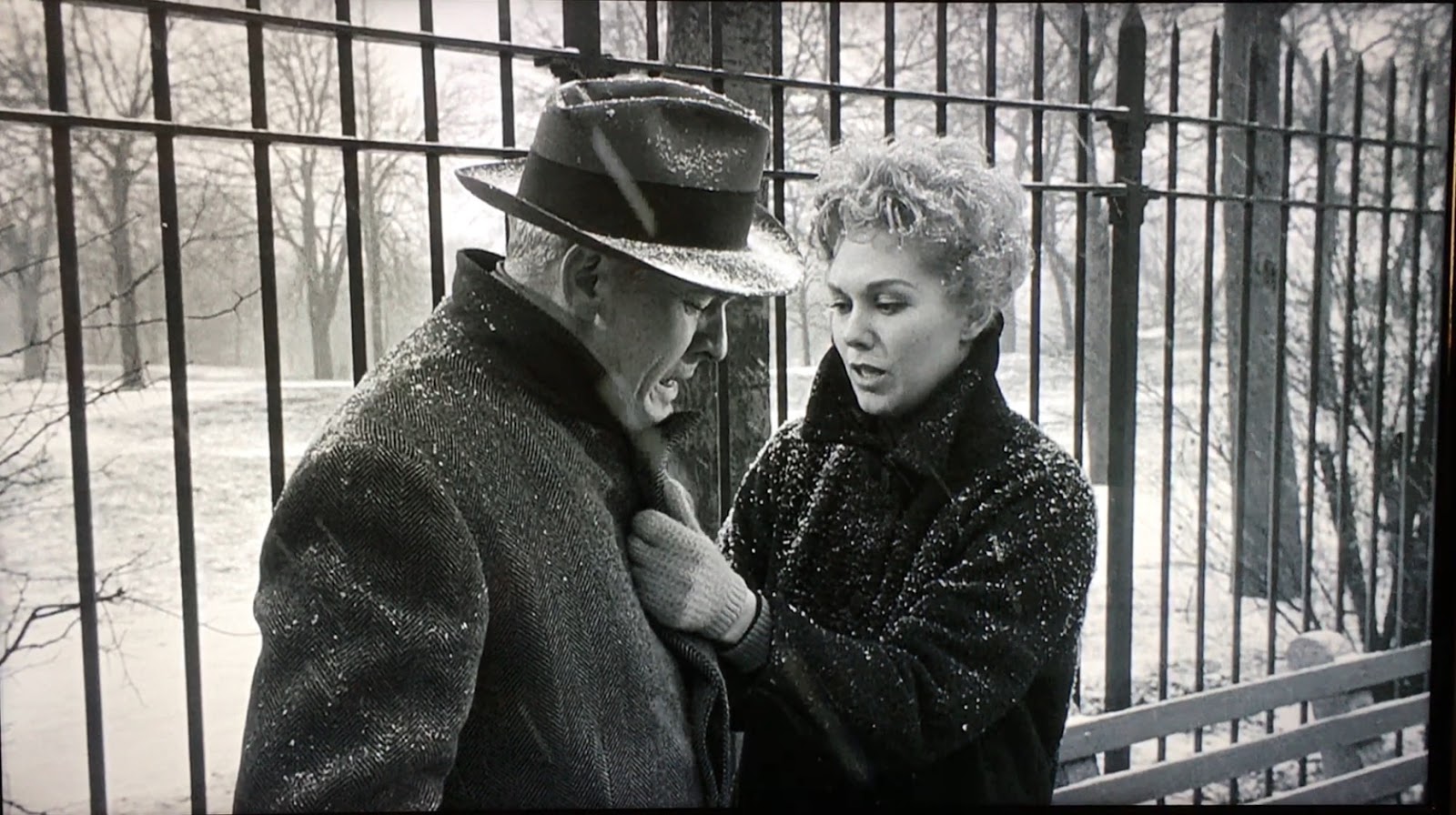
Middle of the Night is a very fine movie. From the leading players on down it is filled with the best actors available. It is shot in B&W on location in New York City. It has some of the best, most real feeling, New York scenes in any movie. It is shot in the winter and the New York winter is allowed to be itself in a way unusual in movies. Principal players do an important  scene in Central Park on a snowing dark cloudy day. Fredric March walks across the street on one of those days when it is sort of raining or snowing, and the street has water puddles and snow and slush. I don’t think I have ever seen a shot like that in a movie. The apartments are real NYC apartments not the enormous apartment sets often in movies that any New Yorker can see as unreal.
The movie is unusual and special because it takes on this topic to begin with. It is a justifiable criticism of movies through the decades that older leading men movie stars are often put in romantic situations with the new young starlet. Like a 25 year age gap between a Cary Grant and and Audrey Hepburn, etc.
In this movie Fredric March plays 56 but he is really 62 and at that age is no longer that handsome leading man of 30 years before. His eyes look saggy, he in not fit, has a belly, he is just not a sex symbol. The woman is played by beautiful blond Kim Novak. She is supposed to be 24 in the movie and is in fact still in her 20s when the movie was made.
He is the boss, she the receptionist, their relationship is not equal, she is a confused divorcee who lives in a very modest apartment with her mother.
He is a widower, has a nice apartment, falls in love with her, is physically forceful at one point, and she is more or less going along with his expressed needs and adoration. But it is not coming from her. He is driving it.
The script is very well crafted. Paddy Chayefsky put his skill as a dramatist to use in this very fine well directed and acted movie. Chayefsky was only in his mid 30s when he wrote this. I don’t know what attracted him about the situation. It has a satisfying yet opened end finale. It is a very good movie.

But what if the man is not particularly powerful? What if he has been more or less a slacker? What if in opposition to having this attractive wealth, he has literally nothing, lives on a tiny fixed income? What if they, once together, have to move in with her parents because he doesn’t have that fancy apartment to share?  There is another side of everything. There is an enormous variety of human experience so this type of May - December relationship happens too.
What if they are same sex or trans people? And a 30 year difference is not the same if the woman is 34 rather than 24, or 44 to his 74.

But what is the drama if there is no disapproving daughter the same age as the young lover? What if she really loves him for the sad lost human he is, who is open about his humanity and capable of a warmth and connection that she finds rare? Well, there might not be a lot of movie type drama in that. These might be the kind of issues that cannot be easily seen in the voyeuristic manner of looking on at lives via a play or movie and judging the characters by their movement and actions rather than what might be going on constantly within them. In this situation she might really adore him but wonder how she will support him and herself, especially as he gets older. She might feel frustrated that she can’t fill out his dreams.
He might worry that he is using up her youth. That he can’t provide for her and liberate her from the drudgery of work or get her a nice place to live like, as he imagines, many other men his age could. (The ones in the movies who have worked hard and accumulated wealth over the years and still have some after the settlement with the ex.) He might be concerned with his health as he ages. He might be OK for the time being and virile enough, but how long can these things last? After all 50 doesn’t seem so long ago, so 80 is right around the corner, it’s it? He might worry that he is not fun enough, and been-there-done-that on too many things she still needs to do. But day to day there might not be a lot of visible drama and it is not easy to show in the movies. But that’s why novels can be so superior to movie fiction, that real internal stuff.

Middle of the Night, written and directed by men, is from the male point of view. It might be somehow progressive for it’s time, but it is still written from the mindset on the 1950s patriarchy. If the culture is to move forward we need to hear from a much wider variety of voices sharing their relationship experiences. Stories like this can often feel terribly stale, along with the male point of view dominant in corporate media, there is also the competitive factor so supported by corporate media with it's endless jealousy stories. Like I said before there is a wide variety of age variant relationships. Same sex, trans, polyamorous, on and on.

In the story of Middle of the Night, why couldn’t she have her retuning young male former husband and well as the older man? Why are they viewed as redundant and competitive when clearly they were suited to and helped full entirely different areas of her emotional need?


MOM

How to destroy a young woman's life? It's really not so hard. Be born to her She was only 19. I understand that she was good in scho...