Tuesday, December 6, 2022

Groupies by Sarah Priscus

 Are we all groupies one way or another?


With Groupies, Sarah Priscus has produced a fine first novel with an engaging story and a handful of believably human characters.

It is a period piece set in the late 1970s mostly in Los Angeles. This is the world of young women orbiting around the male power center of a famous, very successful, rock band.
How successful? There is a scene in which the band, Holiday Sun, flies to NYC to appear on a TV show modeled after Saturday Night Live, so THAT successful and high profile. 


The story is told in first person by Faun, a young woman from Massachusetts who has just arrived in LA to live with a childhood friend. 

This old friend has been out there for a while and has become the girlfriend of the lead guy in Holiday Sun, a British musician Cal. Faun is a photographer who shoots polaroid instant image film. She intends to use the association with the band to help launch herself into a successful photography career.

Given the time/place setting in high profile showbiz the novel could attract readers interested in the music business and this LA period in particular. In that way, it could find readers who look at the story closely, search for clues, and speculate on historic models of the characters and band.
Perhaps the novel is better viewed in the wide angle of American culture beyond the music biz; seeing it as a story of people attracted to power and attempting to get something for themselves from it. This gives the whole story and greater meaning and a significance beyond a rock or showbiz novel.

Much of the dynamics of the theme could be shifted to a story about cults or political power. In the story the rock dudes find themselves in power. That offers them via female fans. In this way the novel looks into the world of male stars who feel entitled to “grab them by the pussy”. Priscus tells us that the women, the groupies are primarily there for a type of supportive loyalty that can be assumed and relied upon by the power males. They pump the boys up.

The men/boys are at core needy, insecure in their precarious power positions. They need the backup of these attractive young women. The women are expected to be “true fans”, sincere and loyal. They need them in a way similar to a Keith Raniere, Harbhajan Singh Khalsa, or back to the LA music scene, Phil Specter, who was so needy he would repeatedly, for decades, put a pistol to the heads of women who wanted to leave to make them stay with the ultimate result of that.

In a way it is a crime fiction novel.
Who is the perp?
USA cultural and political life as we have it and must deal with it.

The time setting of 45 years ago is not more innocent, merely less equipped. The technology of social media and continuing media business consolidation/centralization with algorithmic personalized diffraction and separation, empowers marketing, powermen and corporations. The boys in the band are not all that bright and don’t have the power of certain tools of control. No one in the novel is super villain sinister and about to build a multl-level marketing system of branded sex slaves, but at core is all sadly the same. None of this takes anything away from this interesting and entertaining novel and story.

Is this a hero's journey type of tale? It’s better than that. Maybe a more realistic anti-hero novel. The groupies provide support for the band but every one of them has their own angle, their own wish for transcendence and immortality by their sucking up to glory. If they do THIS, they can maneuver themselves to THAT. The novel provides a clear view of a culture gone wild with need, greed, and lust for some kind of meaningful life within the atmospheric chaos of the marketplace. .  

Are we all groupies one way or another?

Page 348

“It was a study in groupiedom. In pain. In joy. In good. In evil.

In life.”


Thursday, November 24, 2022

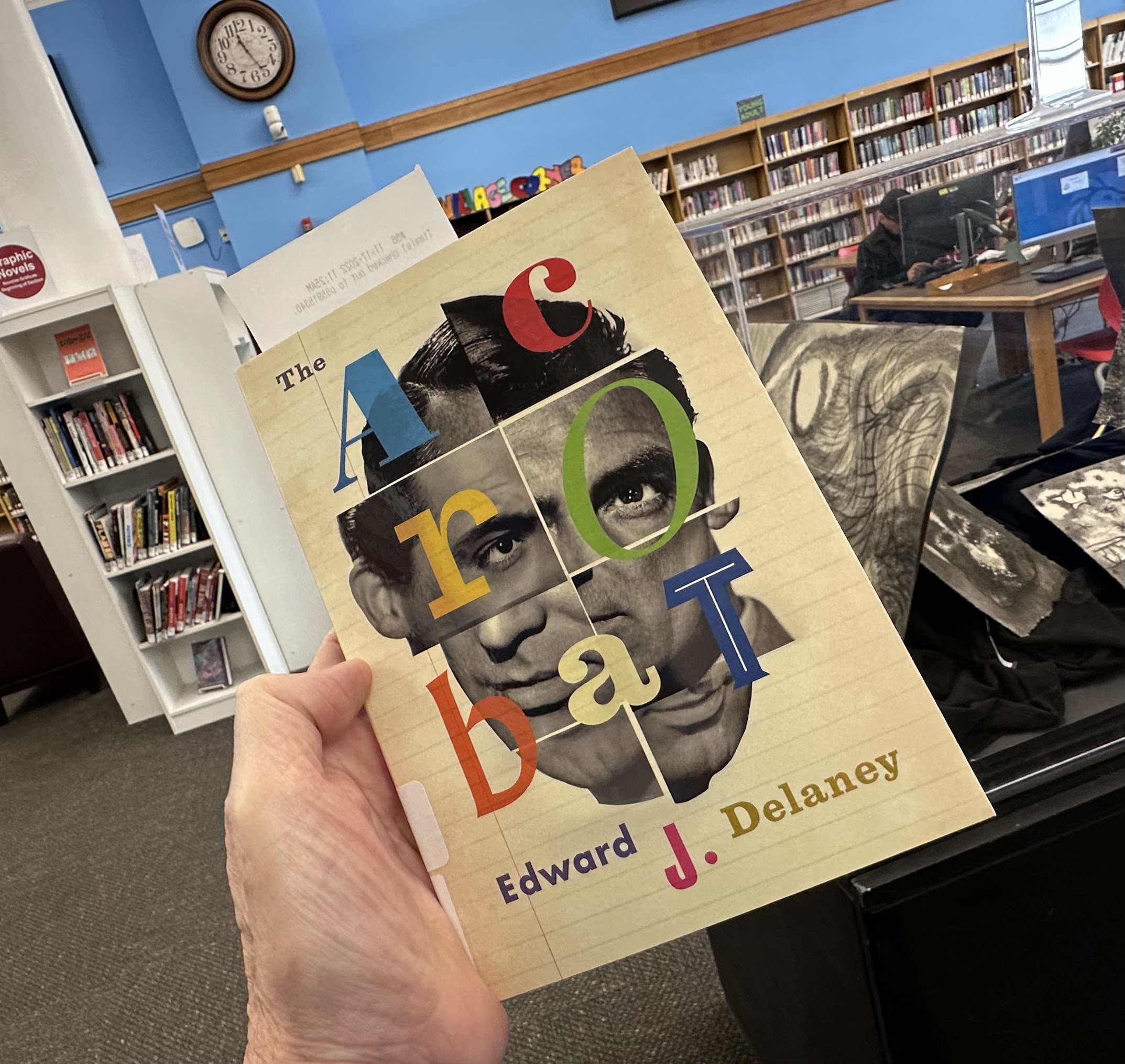
The Acrobat by Edward J. Delaney

 The Acrobat by Edward J. Delaney


This is a fictional biography of a fictional person. It includes the contemplations of the real person who transformed into a celebrity and what he makes of the happenstance of this bizarre international movie stardom.

The real person fictionalized here is Archibald Leach, the son of, not even a tailor, but a pressor born and raised in Bristol, England. The fictional person fictionalized is Cary Grant. The novel deftly time travels through the early years of the acrobatic vaudevillian, gently bouncing us to the mind of the 50 to 60 year old star as he looks back at what was that all about while deciding what to do next.

The Acrobat, published in late 2022, is also timely in that it explores the LSD psychological therapy he undertook. There is a 21st Century resurgence into the idea of using psychedelics as a powerful tool for personal growth and renewed understanding of oneself.
The novel fits in with the work of popular best selling author Michael Pollan’s How to Change Your Mind about his late in life explorations of various psychedelics. A follow up book This is Your Mind on Plants expands that study. How to Change Your Mind has been adapted into a four part Netflix documentary series which is bound to reach far more people than the diminishing number of book readers in the moving image age. The series serves as almost a commercial for psychedelics in that it is a far more positive view of this stuff than mainstream commercial entertainment did the first time around when it ping ponged from ridiculous and ineffective propaganda such as Art Linkletter’s unfortunate daughter, this is your mind egg in a frying pan PSA TV ads. All this after an extremely confusing introduction of the substances via hit new music, Are Your Experienced, rock star Beatles, and Leary evangelical promotion.
Another art LSD project played NYC last year. This one oddly enough was a Broadway musical Flying Over Sunset (FLYING OVER SUNSET - Montage). This musical is by James Lapine, a hit show maker with Stephen Sondhiem in the past and played at Lincoln Center. It is about the psychedelic explorations of Aldous Huxley, Clare Boothe Luce, and Cary Grant. (This writer has not seen or read this show's book.)

This reader tries to stay clear of celebrity, movie, rock star biographies. The notion being that after the early wannabe years in which bio info of stars might be practical and instructional, there is little point at gazing up at the kings and queens of our culture. Their lives are so extreme and odd they provide little useful info to the common person. We are all complicated and human, it is really more interesting what the simple complicated folk do to get by than the rags to riches freaks among us.

So why read The Acrobat? This reader was interested in the popularization of LSD, the new interest in it and how it was going to be shown in the novel. It was not new information that Cary Grant was an advocate and participant in LSD therapy. This reader in fact asked the star about this in a Q&A segment of a traveling live show Grant did 38 years ago at Proctor’s Theater in Schenectady, NY in 1984. The question was about LSD and he didn’t back off in the slightest. The battle shaming him over this was almost 25 years in the past. He said it was a significant experience for him. https://www.carygrant.net/articles/schenectady.htm   

Cary Grant oddly enough was one of the first high profile personalities to talk publicly about LSD therapy and how he felt it benefitted his life. There was Huxley of course but not a movie star and not the biggest of movie stars at the top of the heap like Cary Grant. In this novel it involves a situation of mentioning it off hand and off the record to a showbiz reporter, but Grant thought this could harm the business of two movies he had in the can: Operation Petticoat and North By Northwest. So he denied ever having spoken to the reporter which couldn’t work out for him since the reporter had recorded an audio tape and also had photos. The reporter sued the star for defamation and they settled in a way that involved a wider distribution of the LSD story. Ultimately it was not a problem and had no effect on his career.

Grant was introduced to the therapy through one of his marriages, to Betsy Drake. They had met on her very first movie Every Girl Should Get Married. So naturally he married his co-star who should get married and did. They were married from 1948 until 1962, his longest marriage and her one. Betsy Drake never remarried and eventually got a Masters of Education from Harvard and became a child therapist while having no children herself. With the two of them hings had gone bad when he had an affair with Sophia Loren while they were making a movie together and wanted to go off with her except she then married Carlo Ponti. So Drake went to Dr Mortimer Hartman as part of dealing with the upset in their marriage and suggested that Cary do as well.  

The novel handles the LSD experience quite well. This is done by staying away from dealing with it directly. The chapters tend to begin with an italicized page of two of dream like scenes, These could be interpreted as compilations during the blindfolded LSD sessions, but Delaney doesn’t tell us directly that it is a function of the LSD. This is the safe route. LSD, psychedelic experience is not easily or at all explainable through text and speech, and it’s the type of thing that one cannot assume is like alcohol or some other drug or cannabis. From reading the novel it is impossible to tell if the author himself is experienced and that is just fine. The focus of the novel is the turning point of an aging man in a very odd position in life that he doesn’t entirely understand since his life had become the role of Cary Grant. This gives the novel the appeal of a story that the average reader can get something from. Aren’t we all in masks, playing a type of role that is us but also oddly not? The novel is good in that it focuses on the point of the therapy, not the tools used in exploration or the razmataz special effects that the tool is famous for.

This fine, entertaining, short novel (267 pages) is packed with info on the early years of Archibald Leach through to the early 60s when he is pushing 60 himself and then stops. If the reader is already aware of the biography of this man, they might still get an interesting take on the star from Delaney’s point of view. Others will get an adequate amount of bio information to suffice and a good story about the inner workings of an aging and somewhat alienated man. It also shows how a difficult situation of a boy child and his mother, a confusing separation, can cause the man to perhaps have a hard time staying and trusting a long term relationship with a woman, a marriage or facsimile.

Recommended 
The book was a New York Public Library brand new paperback.
Free ride. 
       

Friday, July 22, 2022

Dead, insane, or in Jail by Zack Bonnie

This is a story of someone on the powerless side of family conflict. Nothing particularly rare just another one of the common products of our social system, the “Troubled Youth”
They go with the “Concerned Parents”
This is Zack Bonnie’s memoir of his time in the family role of “Troubled Youth” even if he didn’t feel like he fit the role at the time and wondered why he was being sent to a horrible concentration camp out in the middle of nowhere.

Zack is a child of so-called “privilege”, There can be countless benefits to a youth from parents with money, but Zack is on the receiving end of the horror ignorant and distracted wealth can hire in an attempt to correct relationship and discipline problems in children. The acknowledged experts of a given era may not be as enlightened as they are perceived to be. These things seem to flow with the fashion of the times and 14 year old Zack finds himself in the late 1980s before light was shed on some of these businesses.


Zack gets shipped off to deep rural Idaho to a correctional boarding school experience. Much of the treatment there involves abusive language and group therapy or more like regurgitations of traumatic situations in the past that are said to have brought the child there. The methods are an evolution of the Synamon program and launched by one of Synanon’s graduates. 


Much of the early and middle part of the book involves scenes from these hardcore, kind of like, Basic Training, marathon group sessions. This makes for an unpleasant time for the reader with pages of bickering and abuse from leaders that is intended to break down the youth who will be rebuilt via hard work and proper thinking, or something like that. Be that as it was, it filled me with doubt that Zack Bonnie could actually deliver a readable story version of his life rather than a therapeutic purging.

Maybe the writer should be considered courageous for daring to present us with a reading experience that evokes the tedium, boredom, and the “get me out of here” claustrophobia of the remembrance. 


There are other books that continue the story. I think I have all I need for now since it is not a pleasant place to be and the resolution seems to be books ahead.. 


You can hear Zack Bonnie tell part of his story on the IndoctriNation podcast


Sunday, July 10, 2022

Glass People by Gail Godwin

    I’m alway reading a book. It’s a bit of a habit. I’m not about to claim that it is some lofty habit or more wholesome than others, but to me it is a form of entertainment that is generally, almost always, a deeper consumption experience than some others, such as moving pictures. Due to this habit, a certain feeling of immediacy comes over me when I finish a book and I want another ASAP. Some things I plan to read, others are picked up as they come my way.

  Last week I was on the way to work and had time for a book exchange at the big new public library of 42nd St and 5th Ave. Sometimes I know what I want and where it is. This time I just grabbed Glass People on the shelf. The thoughts into this>browse fiction>want to read something by a woman (I like to mix it up)>Hmmm?!?Gail Godwin>heard name, never read>this one is paperback>thin 200 pages>I’ll just read this.
 
  Glass People was published in 1972, 50 years ago. With focus on the woman partner, It tells the story of the early days of a marriage. Francesca is a pampered beautiful young wife of an ambitious city prosecutor who is running for state attorney general.     

About a third of the way in Godwin delivers this little character study of the husband:

“He sat eating his breakfast, sipping the freshly ground

coffee, wiping his lips with a napkin, thinking. He was not

a villain, no. Unless your definition of a villain was that of

a person who spent his whole life being disappointed in

people. Whose fault was it if people entered his life disguised
as more than they were and, once inside, flung of

their masks with relief and revealed their paltry selves?

They then blamed him for not approving of them any

more. They called him "inhuman, "unable to love, "'sadis-

tic. By human they usually meant mixed up, a mess of

unthought-out reactions. By love they usually meant need

or fear. And his sadism was simply a matter of letting

them stew in their own juice while he looked on, arms

folded over his chest, a curious wonderment in his eyes

that they could not see, could not really see, that they

had jumped into their dreary mess all by themselves.

   Your standards are too rigid, Cameron, acquaintances

had said to him for years.

   But I don't ask anything of anyone that I wouldn't ask

of myself twice over, he would reply, meaning it. He knew

he had more will, more energy, more patience to wait for

what he wanted, more intelligence than most people.”


  Apparently the husband is not troubled with doubt and its companion self consciousness. He is kept remote and mysterious in the story. There is the above which gives the most insight, beyond that we only see him through his actions and how they affect Francesca. He is presented as one who is unruffled by his wife’s ennui in the new marriage. He is entitled to propose a cure. He suggests that she travel across the country to see her mother.
  This happens and she is off to see mom who is with a new man, her third and gone, sort of, back to the land under his influence.
  On the way home she meets a man who influences her more. Now that I’m writing about it it becomes clear that the book has this gender power dynamic going on. She is influenced by her powerful husband, her mom has changed because of this new man and Francesca is following the notions of the man she met who represents himself as a helper, when he might just be placing her where she is accessible to him.

  This novel is very 1972. The novel is influenced by what has been called Second Wave Feminism, roughly the 1960- 70. It is not at all preachy or agitprop. It is questioning the patriarchy by showing it to us in the story. The characters are all trapped in it. Francesca is on a journey to remedy her discontent with her life.
There is a resolution, but since she is still very young, the reader can imagine a future when she will be fed up enough to get out into SOMETHING ELSE. She was just not ready yet, she doesn’t have to change. And besides, the 1972 culture might not be ready yet either.

  Oddly there is a familiarity about this novel. It is somewhat like Keep the Aspidistra Flying by George Orwell.That is also a story of rebellion from an unpleasant situation with little control. In that the main character wants to be free of his work, to be a poet and live for art. He leaves his job writing advertisement copy to do this but soon finds himself in another form of misery; a life of poverty. His life spins out with worry and scarcity.
  Both these novels are too realistic to give us that fantasy happy breaking away of a newly autonomous contented individual. They both end in the same fashion. The stakes were not high enough for either of these protagonists to follow though. They are middle class people accustomed to the shelter of that bubble. It's easier to go back to what was known, available, and good enough in its way.    

Glass People is a successful novel in that it artfully shows a true moment. I like books like this. There are too many heroic or anti-heroic stories, melodramas, influencing us. This is down to earth, low key, and real.    


Wednesday, June 29, 2022

Squeeze Me by Carl Hiaasen

This is a crime genre novel that is also an entertaining satire of a Donald Trump type in the inexplicable role of president of the USA.
Carl Hiassen, born and raised in South Florida, sets the story in Palm Beach and fills it with ridiculously frivolous older-rich-women, Trump fans. They have named themselves in reference to the “pussy grab” line from tape that was released while he was running the first time.
There is also a mirror image of the Trump Palm Beach place, Mal y Loco, or whatever it is called in real life.

Rich in plot and events, the book is quite up to the minute on trends in the media. There is an LSD microdosing element to the story that goes to a surprising and comic dosing. You have to read it to find out who was dosed. (No, not HIM.)
   
Squeeze Me refers to pythons, invasive creatures not native to Florida. They are sold as pets and kept until unmanageably large which gets them dumped into the Everglades to thrive or die. In the story, some grow to 25 feet in length.

The cast of characters, along with the Trumpish cartoon, include, local cops, Secret Service agents (not above getting close to their work), a swamp hermit, and a freelance animal control woman, who is one of the main players in the dramcom.  

I had a good time with this one. 


Tuesday, May 24, 2022

The Magnificent Ambersons by Booth Tarkington

    Cinema fans will know this property as the second feature Orson Welles shot at RKO. Then the studio tested the movie in a preview somewhere and decided to rework the ending and trash what Welles shot. Did they really not think it worked or was that part of the "comeuppance" that the old guard had in waiting for golden boy Welles? What remains certainly is worth watching, it's really good in fact, but likely would have been better and a bit edgier. Actually they have been hunting around in Brazil or somewhere in South America for the lost footage. The idea being that Welles was sent to South America on a wartime goodwill mission at the same time that RKO was trashing his footage and he might have had a print with him down there (or some such, I haven't really been following this recovery search story).

This is not about the movie but the novel. The novel is quite good. I gave it 5 stars on my Goodreads. Published in 1918 it has some kinship to other novelists on the period, Theodore Dreiser (From Indiana, like Tarkington, but working class immigrant stock), Frank Norris and some others, sweeping realistic work that emerged from the social and political changes of the new century.  

This is the second novel in Tarkington's Growth Series, which chronicled some of the enormous changes that hit the USA with technological development and the rise of factories and industrial work. It deals with the life of a rich pampered child George Anderson Minafer. In fact the earliest movie version of the novel was called Pampered Youth (1925) of which only an excerpt survives. (One can watch this on youtube presently. May 2022. Typical Hollywood product that changes many things, little things like names, then they add a horserace and a big fire, cinema action, that takes us to the happy ending absolutely different from the events in the book.)  

If you have seen the movie you know what the plot basically is. This brat George is the town rich kid and people are waiting for him to get his "comeuppance". His bratty attachment to his mother ends up disabling him, throwing himself, his mother, and Lucy Morgan and her father Eugene into lives of longing and lovelessness. 

The novel spends a good deal of time looking at these rapid changes to the fictional "Midland" city. It shows how the car culture made the old town sprawl out from the suddenly old city center into the burbs. It explains how the impulse to get out was propelled by industrial pollution from the new factories and all the coal fired furnaces in town, industrial and domestic. He talks about the soot covering everything so that people painted their sooty dirty white houses some darker color so as not to show the dirt. I remember when I was a child in the mid 1950s in Ohio. We lived for a time with my great grandmother who had a coal fired furnace in the basement. There was a very small ground level door and coal chute to the outside for deliveries. Yes, Canton center was more or less abandoned by the time I was around but reading this and connecting it to coal soot and general industrial pollution was a bit of a revelation of a further cause for sprawl. I suppose there is something to that.

I like these artists that are critical of the automobile. Jacques Tati with Traffic is another beloved auto critical artist.
Negative issues about automobiles are stated in the book, mostly from the brat George, but these are kind of left for the reader to finally judge.  

What did I expect based on what I knew before? I expected a portrait of a narcissist. And I expected to be able to look down on him and his ancient ideas of class and "what will others think?".  

What I got instead was a rather disturbing portrait of myself in the form of this brat George Minafer. Except I turned out a good deal worse. I didn't even get the mother love part like George had.
The strange thing is that I didn’t have the class background of George. I was not the son of the city’s rich man. But entitlement of a different, more ignorant, sort can arise. In the mid-20th century the working class could shelter their own children from the realities of the marketplace that is our world. TV helps. I lived in a magical world of TV stories. There seemed to be money. I had what I wanted, if I ever really wanted anything. My parents were able to buy a 1964 Chevy Impala brand new. I remember being in the showroom looking at the SS, Super Sport, models. This became the car I learned to drive about 4 years later, with driver’s ed at public school. Then my parents built a big new split level house on a wooded lot on a hill. Where did all this supposed wealth come from?  They both worked at jobs for wages. The jobs were off stage from my life. I never saw what either of them did or where they worked. They just went away every day and came back able to buy a house, a car, lots of Sinatra LPs, a color TV. I was sheltered from what they did. I knew my dad worked swing shifts but what sort of hellhole Republic Steel was I didn’t experience. A high school dropout, his union wages allowed me to think I was middle-class. In the novel George refers to new people as “RiffRaff”, but the alienated suburban youth can transform his very own worker parents into the riffraff in his life. They are the ones kids desire to get away from and who we look down on for their lack of sophistication.   

Like George I didn’t really have a clue about what it really took to get on in life.
George intends to live without a profession.
I wanted to live without a job.
George is worried about what other people think. That an old fashioned notion isn’t it; caring about what the community thinks? I have done that a number of times mostly out of my own shame. Last year I ended a long love relationship with a younger woman because I was worried that since we worked at the same place people would look down on her as a daddy chaser and me as a little girl chaser. That grew out of a comment by a friend who was prejudiced because he was into the daddy dom thing himself and projected his thing on to us. Based on that I saved someone who I really loved and who loved me by getting her out of the situation of relationship to me. This was a disaster for her and me. Terrible, unforgivable.

I’m not exactly sure how the mechanics operate. But I think it was something in mass media that cut me off from my parents and the world around me. Of course my parents were very young and didn’t really know how to inform me what I needed to get through life, other than mom wanting me to do good in school which I was just afraid of and failed to do anything other than squeeze by.

I’m not unique. I feel kind of secure in stating that we are a Brat Nation. There is something in our nasty culture that makes people this way and it is not something that is fading and lessening. It is advancing. We are turning out brats.
That Capitol Building Jan 6th thing can be seen at a Brat Attack, distorted insane white people.
I didn’t expect this old novel to take me into my own life and current events as it did. I regret that the country and culture did not change fundamentally and become more healthy in the 104 years since the publication of the novel. Are we locked into this self destructive path? Apparently.


Monday, May 16, 2022

Yippie Girl by Judy Gumbo

 Rolling in late, comes this 1960s movement memoir.


Late because we are deep into the 21st Century now and embedded into someone's World Order in a way that can feel not much more than. . .hopeless.

This memoir could be a joyous read had the movement it is about not been a total failure.
The 1960’s Anti-war and black liberation movements could not build the class solidarity of the temporarily successful labor movement of the early 20th century. That type of massive solidarity was what was necessary to bring change when the power system was vulnerable after the 1929 economic collapse. The 60s movement never had that solidarity or collapse. It was a time of general prosperity, and no matter how nostalgically some of us feel about the youthful exuberance of the “revolution is just around the corner” things are far far worse today than they were in 1970. The movement for economic justice is a failure.

The book is an example of this collapse of common cause solidarity since much of it is really an old comrade saying that she was there and part of it but being a woman was kept on the margins. I have no doubt that this was true and Judy Gumbo has every right to toot her horn and ask for acknowledgement. OK, but now what? And what happened after? She mentions being a very good fundraiser in later life but we hear no more about that. The story kind of ends with the 60s events and the VietNam war. Being a successful fundraiser for Planned Parenthood might be a more heroic story to leave behind than memories of a flashy youthful failure of a movement. 
But then I probably wouldn’t have read Fundraiser Woman so the circle is complete I guess and sensation sells.

She comes into the yippie movement directly out of the old movement. She is a Canadian Red Diaper Baby, her father a lifelong career Communiest Party type who built a successful livelihood out of it as a promoter of Soviet Union concert performers in Canada.
This transition from Red Diaper Baby to yippsterville is not really explained. She wasn’t particularly a hippy or acid head, she was a divorcee who dumped her hubby really quickly when she discovered him in bed with another woman. (No hippie Free Love for Gumbo. Later in the story, polyamory was considered and rejected for monogamy.) It seems that she became a Yippee because she became the girlfriend of one of the three main OG yippies, Stew Albert.
From this origin information one could conclude that she went from old school commie daddy to cutting edge for-the-hell-of-it Yippie daddy. But telling it that way kind of derails the neo-feminist train and so it’’s best to not look at it that way. We all have to do what we have to do and times are different than walking a mile in anyone else's one toe loop authentic Indian sandals.
Why does she repeatedly mention the infidelity of her first husband? It seems a sore point even now 60 years, or whatever, later.

I don’t know, for decades it all seemed so recent and immediate, but now just very remote, far away. That movement now seems like an echo of an after shock, of the big somewhat successful movement before it. But we all will remember the hit, rather than the spin off with the kids in charge every week jumping the shark to get attention while sinking to the bottom of the what matters chain in the neo-liberal world that dominates and gained power in the last 60 or so years. The hit movement being the early 20th century movement that brought us SS, The kids movement, the Yippies 30 years later making a splash then passing on while I still have the benefit from the earlier movement. Monthly Social Security.

The movement that pushed the government into Social Security was a great movement.
Its gains have been attacked by those always opposed and now they are winning. Finally destroying what was left in the New Deal era, the legitimately helpful Big Government. Meanwhile the corporate welfare and military goverment is growing and giving out even more power to those already in control.

So yeah, we boomers can look back at the glory days of the Chicago 8 show or whatever but we failed to even protect The New Deal.
Most of us have been well placed enough to ride out whatever insanity the USA comes up with. We survived Reagan, the Bushes.
No problem, we are still here if we can set our tolerance for the unacceptable ever higher. We have to tolerate the USA for 20 years tearing apart Afghanistan for really no good reason at all and now leaving them starving. We have to tolerate that voting rights are being taken away in favor of Republicanism. We have to tolerate the loss of abortion rights.
We have to tolerate the trickle down of death from the military-industral-news/entertainment complex that is in control of most of the national money, power, and consciousness.

We have to tolerate this or else die in our isolated social distant despair.
So we tolerate it. We are physically comfortable enough to not let it all get to us too much, plus that is that interesting new cutting edge series we are all streaming.  And weed is sort of legal here and there. All is more or less well for the aging white baby-boomers.
Maybe there were a million deaths in our name in the past 20 years but it doesn’t affect us enough to really do something about it.

I’m really complaining about our time through looking back at what we may have wanted it to be. There is nothing wrong with the book. It just hits me at a particular moment of hopelessness about The Revolution.

Stew Albert, the eventual spouse and babydaddy, was close to Jerry Rubin so there is more of the Jerry angle of things than the Abbie Hoffman side. They were often at odds and took their personal followers with them. Albert was also friends with Elldridge Cleaver, Black Panther leader. The stories about him are perhaps the most interesting in the book. 

Back then I was a Abbie Hoffman Yippie, or identified as such. I even met him for a moment at a big MayDay rally on New Haven Green 1970.
I was brought into the movement, as much as I ended up participating, which wasn’t a lot, by seeing Abbie Hoffman in the mass media when I was still in high school (Merv!) and wanted to be a hippy, now Yippee! But we still had hair length rules in high school, Bummer. Abbie was always very funny. He organized me. Brought me into the movement still as a kind in Ohio.
Later, after high school, I took LSD as soon as I was offered and loved it. I still love it and use it occasionally. In the book Judy Gumbo says she tripped only three times and the last years ago. Time for a booster granny! 

The book has one very sad story about insane Phil Ochs who at the end of his life visited them for a day, part of the time as his evil alter ego John Train. But nothing about Phil in his prime of any of the other movement performance people reviewed. Phil Ochs was particularly dear to me in my youth, he was a suicide at 35 and I kept on singing his songs for years. So, yes, a sad story in the book.
Phil and Abbie much later, both suicides.

Fine addition to some ancient history herein, although not really searching or personally deep and revealing.  


MOM

How to destroy a young woman's life? It's really not so hard. Be born to her She was only 19. I understand that she was good in scho...